Hex Signs
The history and meaning of Pennsylvania Dutch hex signs, from their origins as barn decorations to their modern talismanic use.

Hex Signs of PA Dutch!
Take a road trip through Berks, Dauphin, York, and Lancaster Counties in PA and you are sure to see some Hex signs decorating the local barns. But what are they? Where do they come from?
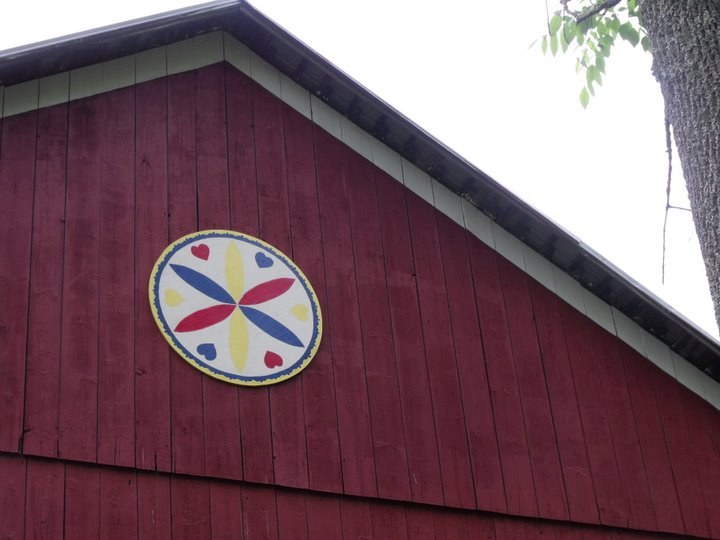
It’s a pretty good bet that hex signs originated sometime in the mid-to-late 1800’s in rural Pennsylvania. We know this is likely because the availability of colored paints was limited prior to this point in time. The earliest examples were probably simple rosettes, as they would have been the easiest to paint; most especially while balancing precariously on a ladder with paint bucket and brush in hand! As time went on, the designs became more and more elaborate and colorful. But the important thing to note here is that they were just decoration.
We can thank the tourist trade of the mid-1900’s for falling in love with the quaint barn paintings of the Pennsylvania Dutch. Speculation about their ‘meanings’ grew and eventually the locals jumped on the bandwagon and started creating hex signs for things like ’luck’ or ‘faith’; and the sale of hex signs to the tourists is still a booming business today.
“A large portion of all the geometric designs found on Pennsylvania Dutch barns can be traced to some form of star, or as they would say in the dialect, Schtanna. Starting with the simple unadorned five-pointed star without a scalloped border, with its wavy up and down quality, is said to indicate smooth sailing on the sea of life. The smooth ring border and the eternal chain both represent long life; they are never broken, so your life should never end.”
From Hex Signs by Ivan Hoyt, Stackpole Books, 2008:
“In recent years, meanings have been assigned to many of the hex sign motifs. When attempting to interpret a sign’s symbolism, look at the combinations of motifs; one motif alone does not define a hex sign’s meaning. The symbolisms here are offered only for your consideration. You may feel, as some also do, that hex signs are ‘Chust fer nice’ or ‘Chust fer so’—simply meant to be a decorative part of Pennsylvania Dutch folklore and culture.
One of the most well-known Pennsylvania Dutch motifs is the distlefink, a stylized bird that can have many different interpretations. Although it can take on features of other bird species, the distelfink design is said to have evolved from the goldfinch. The Pennsylvania Dutch farmer saw the goldfinch bird on the thistle weeds in his field, pulling the down or fuzz from the thistle to line its nest and eating the seed. Notably, goldfinches usually wait to nest until the thistles are in bloom. The Pennsylvania Dutch farmer called the bird a ’thistle finch’ or distlefink. The bird became a recognized symbol of good fortune by eliminating the thistle as a weed in the fields, thus bringing the farmer better luck with his crops and more profit to his pocket.”
The most authoritative and accurate information can be found in Hex Signs: Pennsylvania Dutch Barn Symbols and Their Meaning, by Don Yoder and Thomas E. Graves. The authors point out that whatever meanings have been attributed to hex signs, they have also become powerful symbols of PA Dutch ethnic identity, recognized by the tourist as well as the Dutch. As such, they are widely used to advertise Dutch food and other products.
Remember, the PA Dutch know their history better than the non-PA Dutch. If we say the hex sign meanings were created for tourists, we are telling the truth. Does this mean you shouldn’t use them in your powwowing? Nope! A lot of us like to incorporate hex signs into our Powwow. It’s a matter of personal preference, but with the understanding that it is a relatively new addition to Powwow.
Here are a few examples of the types of hex signs you will see to this day decorating barns and homes in PA Dutch country, and their modern talismanic meanings are provided as well. This information is purely for fun, and no guarantee of the effects of using these signs for anything other than decoration is intended.
The Triple Star Hex — Good luck charm.
The Double Trinity Hex — Brings hope, faith and love to the family.
Success Hex — For wealth, success, and happiness.
Eight Pointed Star Hex — For abundance and goodwill.
Distelfink — Good luck and love for your fellow man.
The Lancaster County Hex — It doesn’t have any mystical meaning, it’s purely a decorative advertisement piece.
Another variation of the Double Distlefink, meaning double good luck.
Known as the “Daddy of all Hexes”, this combination of color and symbology provides good luck all year round. The twelve petals around the circle symbolize the twelve months of the year.
The Distlefink is my favorite hex sign image. The double Distlefink is a sign of Double Good Luck.
The SATOR Charm
The SATOR charm can be copied onto a slip of paper then taped to the inside of your front door to protect your home from thieves and intruders.