Learning to Powwow
Robert Phoenix's guidance on learning Powwow, including cultural respect, ancestral heritage, and the practical steps of Braucherei practice.
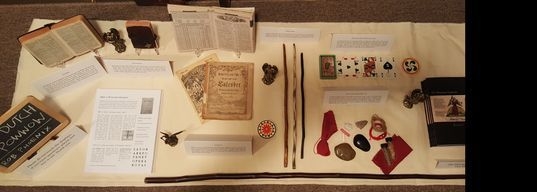
The image above is a picture of my powwow display at Legends and Lore of the Keystone State in February 2018 at the PA State Museum. My personal bible and powwowing book are on display, as are some agricultural almanacs, wands for various purposes, my powwow cane, a Brauch bag, several stones and string and herbs, and my divination cards.
There’s not really a proper way for me to teach you how to do any actual powwowing charms on a website. For that, you may need an actual in-person teacher. However, you can learn all about powwowing from this site and it will give you a good place to start. My advice is for you to try the charms that I have on this site, and who knows, they may work for you. If so, then you may have the gift of powwowing naturally. Some may argue that powwowing isn’t a natural gift. I can’t say yes or no for sure. All I know is that some of the charms I use were never taught to me by another person. I tried them. They worked. ‘Nuff said.
Before I get into the hows of brauche work, I really feel that it’s important to put a little bit out there about cultural respect and the honoring of our ancestors ways. Years ago I felt as many do, that to honor the ancestors, I should go back as far as possible…that somehow the Christian ancestors didn’t count. But as I learn more and more about my own ancestral lineage, I realize that religious beliefs were very much tied into the lifestyles of those who came to America and, in fact, one of the main reasons for their immigration to America in the first place. It would be an injustice and, in my opinion, an insult, to deny that my ancestor’s Christian religion was important. The fact is, the history of PA German culture is also the history of religion in America; particularly within the Lutheran church. And the history of Powwowing is very much a part of that religious history as well. My own ancestors on my father’s side immigrated here from Austria. From those ancestors to the present day, my family has been a part of the Lutheran and Reformed churches in Schuylkill County (they merged in some instances and became the ELCA/UCC congregations we have now). Those earliest immigrants up to and including my own father are all buried in the same churchyard. I am carrying on this religious tradition. My advice to those who wish to remain truest to their ancestral lineage is this: learn about your ancestors. Put names and faces to them. Find out what their religious beliefs were. Find out where their churches were. Respect those traditions. Carry them on. That’s where the real cultural knowledge and ancestral respect is found. When we honor those who have struggled so hard to make a home for their families…namely us, here in this new world, and keep their faith alive, and establish churches and homesteads for us…. we are really embracing the real Pennsylvania German culture and remaining true to the real spirit of powwow work.
Pictured here is my personal powwowing book, a copy of the New Testament from 1896. Inside I have many of my favorite charms written, as well as paper charms and talismans that I’ve made over the years for various reasons. My charm book travels everywhere with me and is always a part of my powwow practice.
It is a tradition within Powwow that a person may not charge money for their work. This is because the power of healing ultimately comes from God, not from the powwower. You can certainly accept a gift, a meal, or some other token of appreciation. But you cannot sell your services as a Powwow.
It is also a tradition that charmed knowledge is passed person to person and that generally the charms are not to be written down. This has been changing in the modern era and many of us do write our charms down for future reference and to preserve the tradition.
Now, let’s get to the hows of the system….
There are a few things you will need to reconcile with yourself before you begin: exploring your current religious/philosophical/spiritual views, and so forth. You don’t need to become a hardcore church-goer in order to powwow, but you do need to be a Christian. In addition to this, an understanding of astrological influences as well as the history of mysticism in Pennsylvania will be beneficial. You will also need to reconcile your practice of magic with the false idea that Christians should not practice magic. Many Christians take a literalist view of the Bible (which doesn’t really work in modern times) and many do not. You must come to terms with this on your own.
DO POWWOWS WEAR SPECIAL COSTUMES? DO THEY WEAR HATS?
Somewhere along the way, the image of a Powwow has become blended with the image of an Amish or Quaker man. It is understandable how this came to be; after all, many aspects of PA Dutch culture are often blended together with the practice of Powwow. But in reality, a Powwow is a regular person, just like you. Just like me. There are no costumes in Powwow because Powwow is not a spectator-oriented show. It is typically one-on-one or, in most cases, private. It is not a group effort. The idea of a Powwow wearing a black suit, black hat, sporting a Biblical name like Abraham or Jacob is a tempting image, but not the reality. As a Powwow, it is entirely up to you which type of image you will convey, but please don’t be insulting to the Amish community (or the PA Dutch) by making your Powwow into some type of silly parody of Pennsylvania Germans.
I DON’T LIKE THE BIBLE AND I DON’T WANT TO USE IT, CAN I STILL BE A POWWOW?
Then Powwow is probably not for you. A serious academic study of European folk magic or English Cunning Craft and the American folk magic traditions; such as Powwow, Hoodoo, and even the spiritual traditions of many First Nations peoples, will reveal that the Bible plays a central role in many of these traditions. The magic of the Bible is intrinsic to these practices and cannot be separated from them. We do not work magic with our own wills, but by the grace and will of God.